

Editor's note: This article was produced by a student participating in the course J473/573: Strategic Science Communication, a collaboration between the School of Journalism and Communication’s Science Communication Minor program and the Research Communications unit in the Office of the Vice President for Research and Innovation.
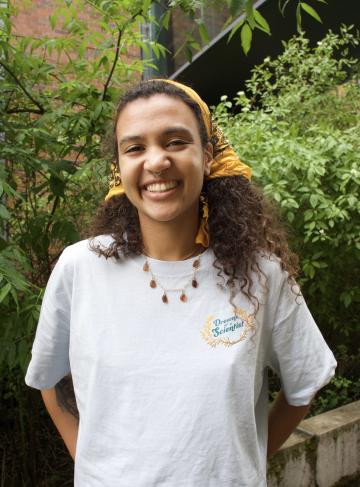
Neuroscience is a complex field, but when it comes to exploring the neural processes of cephalopods – marine animals such as the squid and the octopus, the challenges grow even greater. Understanding the biology and behavior of these enigmatic beings, often living in extreme conditions, presents a unique set of scientific hurdles. Angelique Allen, a doctoral student in the Institute of Neuroscience, has dedicated her graduate education to studying the octopus brain and understanding how these animals create images of their worlds.
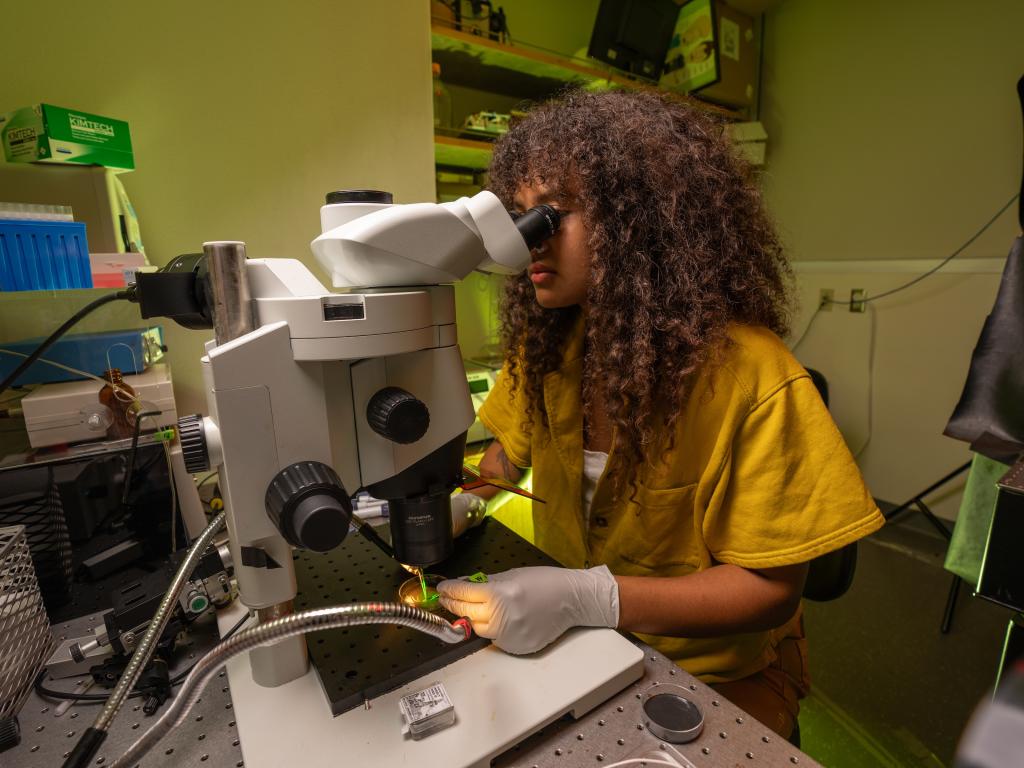
Visual processing in animals, according to Allen, is widely different from humans, and it is broadly defined as how your brain comprehends the visual world around you. Scientists can study visual processing in human beings by utilizing brain imaging techniques, like Functional Magnetic Resonance Imaging (fMRI) and electroencephalography (EEG). Cephalopods, on the other hand, are a bit trickier to examine. “I use calcium imaging, which is similar to an fMRI in the way that it allows you to see activity of the brain in real time,” Allen clarified.
Neurons, or the cells in our brain, are constantly firing in response to the stimulus around us. When a neuron responds to a stimulus, like a movie or a sound that is used in experiments, it spikes. When this happens, negative ions flow out and positive ions flow into the neuron. With the use of a calcium indicator dye, scientists can mark all the Ca++ (calcium) ions with a green, fluorescent tag. As Ca++ is flooding into the cell, the cell fluoresces bright green. This bright green glow is the signal that the scientists want to pick up, and they use very sensitive lasers to do so.
“We’re essentially eavesdropping in on neurons and seeing when they have an increase in calcium. We use a special dye to make the cells glow under a laser when calcium rushes into the cells,” Allen explained.
Discovering a passion
Allen started her undergraduate journey at the University of Missouri studying cognitive perception in lizards. Her desire to study the octopus brain began when she developed an affinity for scuba diving and became fascinated with the underwater world. For graduate school, she wanted to take a different approach and to better understand how marine animals perceive their environment. In order to do this, scientists have to look beyond the eyes and into the brain, since the eyes take in light but they aren’t the organs that are responsible for creating a picture or being able to see, and Angelique was curious to see how exactly octopus brains create images.
“Learning how to scuba dive introduced me to this incredible environment where everything sounds, moves, and looks different. I wanted to combine my experience researching perception in lizards and this newly developed interest in the underwater world. After attending a seminar at the end of my junior year where the visiting speaker talked about her work on octopuses, I realized that studying octopus perception was the perfect way to combine these paths,” Allen stated.
Allen had a lot to learn when she came to the University of Oregon. The University of Missouri didn’t have a neuroscience program or any corresponding classes, so she started her research career in the ecology and evolution program, but that didn’t give her experience in measuring brain activity. She had to gain her confidence in neuroscience and working with octopuses, which came over time.
Her journey from ecology and evolution to neuroscience was not without its challenges, but Allen's commitment to broadening her scientific impact and fostering inclusive research environments propelled her forward.
Life outside the lab
Allen is a Howard Hughes Medical Institute (HHMI) Gilliam Fellow, an award given to around 50 exceptional young scientists each year. Her dedication to science communication, community engagement, and diversity, equity, and inclusion, helped her stand out in the applicant pool. “Putting in the work outside of the lab is crucial,” Allen explained.
In addition to her doctoral studies, Allen has authored a picture book, Dreams of a Scientist: Lessons from the Sea, hoping to inspire the younger generation to become involved in marine life science. The book will hopefully be released by Fall of 2025.
“Art is a great way to connect people to things, especially when it comes to scary things like climate change or complex topics like the polarization of light, for example,” said Allen. Her goal was to try to encourage curiosity about why things in our world happen.
Allen was deeply influenced by the way author Jasmin Graham created her book to make shark science more accessible and inclusive. Allen hopes to elucidate the same meaning with her own book. “Graham’s book, Sharks Don’t Sink, really inspired me,” Allen said. “It discussed her story of being a black woman in shark sciences, and it created a whole organization for minorities in shark science. In a different realm, I feel like I have connected with a lot of people in that way,” Allen said proudly.
Throughout her career, Allen aspires to continue that legacy—breaking barriers, amplifying underrepresented voices, and making science a space where everyone feels they belong.